
I. Introduction to Energy Efficiency Certification
The Philippine Energy Efficiency Certification is regulated by the Department of Energy (DOE) of the Philippines. It is administered by the EPRED Office under the DOE, and the energy efficiency standards are formulated by the Bureau of Philippine Standards (BPS).
The energy consumption label in the Philippines is PELP (Philippine Energy Labeling Program).
The Philippine Energy Labeling Program (PELP) is one of the initiatives of the Department of Energy (DOE) and part of the Republic Act No. 11285, also known as the “Energy Efficiency and Conservation (EE&C) Act,” which was approved on April 12, 2019. PELP provides a national labeling system for Energy-Using Products (ECPs) based on their energy performance.
PELP is formulated to promote the compliance of importers, manufacturers, distributors, and dealers of electrical appliances and other Energy-Using Products (ECPs) sold in the Philippines, requiring them to register their existing and upcoming product models in the PELP system.
PELP aims to empower consumers through the information displayed on point – of – sale labels, thereby transforming the market and encouraging consumers to shift their behaviors towards the use of energy – saving products and technologies.
II. Scope of PELP – Certified Products
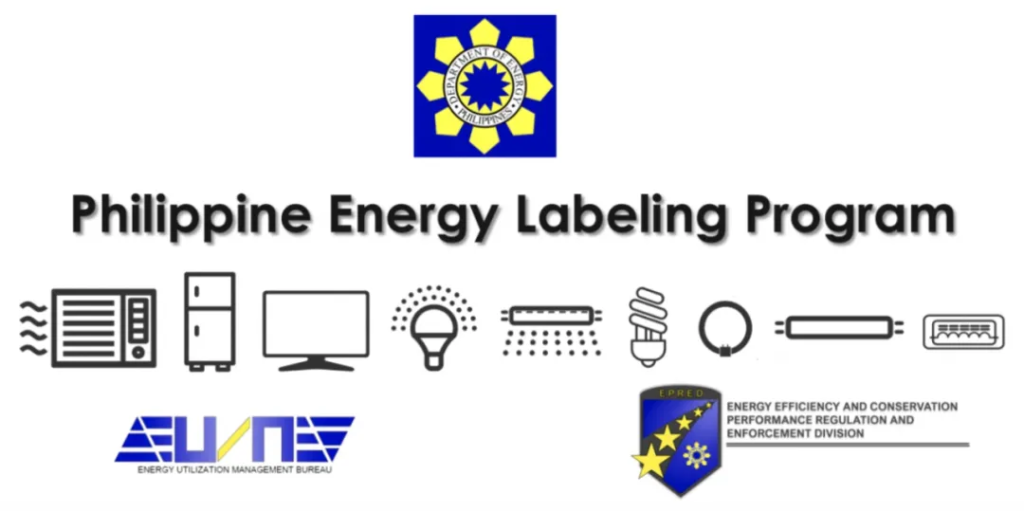
| Product Categories | Product Subcategories | Specific model |
| Lighting products | Lamp ballast ( BAL ), Single-cap fluorescent lamp and round SFL (Self-illuminating fluorescent lamp ) | Power range: 14-40 watts, 230 volts |
| Linear and double-cap fluorescence Light (DFL) | · Power 10-65W (halophosphate)· Power 14-65W (triphosphate)· Power 14-35W (T5 triphosphate) | |
| Self-ballasted compact fluorescence CFL (Card Flask) | Wattage ranges from 3 to 60 watts, and rated voltage is 100V to 250V, 60Hz , with Edison screw cap, especially E14 and E27 | |
| Linear LED lights | Double-cap linear LED light, with (1) G5 and G13 caps or (2) Hat, 230 volts | |
| Non-directional LED lights | E27 and E14 bases operate at 50 to 250 volts. Alternating current, operating frequency 0/60 Hz | |
| Air conditioner | Air conditioner | • ACU – Cooling capacity: up to 50,000 J/H or 14 kW· Split-type: wall-mounted, floor-standing, box-type, and hanging type Top· Window |
| Refrigeration equipment | Refrigerator | · Net capacity is 113-600 liters· Manual defrosting, frost-free |
| TV set | TV set | The screen size is 1.524 mm (60 inches), with remote control. controller |
| Washing machine | Washing machine | For 5 kg to 22 kg, powered by electricity (rated 230)Constant and variable speed engines powered primarily by volts and 60 Hz Fast washing machinea) Manual monocular and double-tubeb. Automatic top loading, front loadingExcluding washing machines and tumble dryers weighing over 22 kg pump/water pump |
| Electric fan | Electric fan | An electric fan operating under alternating current ( AC ) power supply, itsRated input power less than 125 watts, capable of performing additional functions It can (but is not limited to) lights, radios, etc., and belongs to the category ofLower fan type:· Tabletop or standing fan· Table fan or desk fan· Wall-mounted fan· Floor fan, floor fan or box fan· Track-mounted or ceiling-mounted fans · Hanging fan· tower fan· blade less fan Note:· Excluding battery-powered fans· Exhaust fan not included• Includes air circulation and air coolers. Within this range, as long as the physical design or shape meets the requirements.• Includes both AC and DC electric fans· Excludes electric fans that use only DC power.All other features will be turned off or disabled during the test. use |
Among these products, the registration requirement for washing machines and electric fans came into effect on June 20, 2023.
III. Philippine New Energy Label
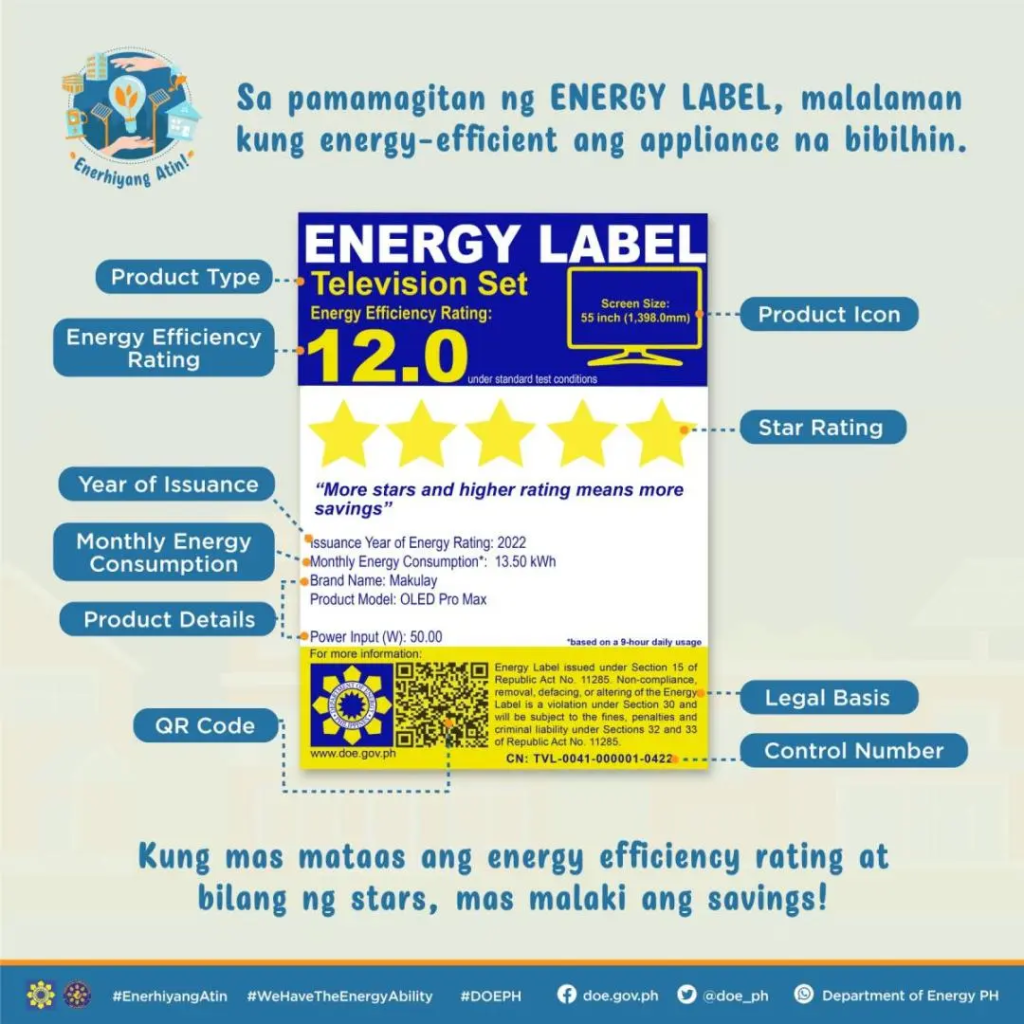
The energy label also includes detailed information about the specific product model and its estimated energy consumption.
The energy label design adopts a star-rating system to facilitate the comparison of efficiency among similar products. The star rating corresponds to the product’s energy efficiency grade, which depends on the CSPF of AC units, the Energy Efficiency Factor (EEF) of refrigeration equipment and televisions, and the efficacy of lighting appliances. Specifically, the higher the product’s energy performance, the more stars it has, indicating higher product efficiency.
To ensure more effective implementation, the star rating applied to energy labels has been aligned with the Minimum Energy Performance (MEP) of products. In other words, the MEP (if applicable) can also be described as the minimum efficiency threshold for a one-star rating. Therefore, products with issued energy labels have also met the MEP requirements of the Department of Energy (DOE).
Furthermore, these energy labels shall be placed in a prominent area on the product itself, such as the front of the equipment for sale. For lighting appliances, the label shall be located on one side of the packaging.
IV. Energy Efficiency Label Certification Process

Step 1: Register a Company Account
Manufacturers, distributors, and importers are all required to complete company registration.
Documents to submit: Company Registration Application, Commitment Letter to Comply with PELP Terms and Conditions, Letter of Authorization for PELP Compliance Representative, and Product Sales and Inventory Report.
Step 2: Product Registration
Each product model must be applied for individually.
Documents to submit: Test Report, and Generic Model Declaration (excluding lighting products).
Step 3: Issuance of Energy Labels
Applicants shall print the labels and affix them to the product packaging or the product itself.
Key Requirements for Labels
1) Labels must be renewed every 12 months.
2) Labels must be updated promptly if there are changes to product specifications.
3) For products with expired labels, the Applicant must reapply for new energy labels. However, no reaffixation is required for products already sold, and the QR code on the original label will display the label renewal progress.
4) For products that do not meet EMV requirements, new labels must be reapplied for, and the labels on the affected products must be replaced.
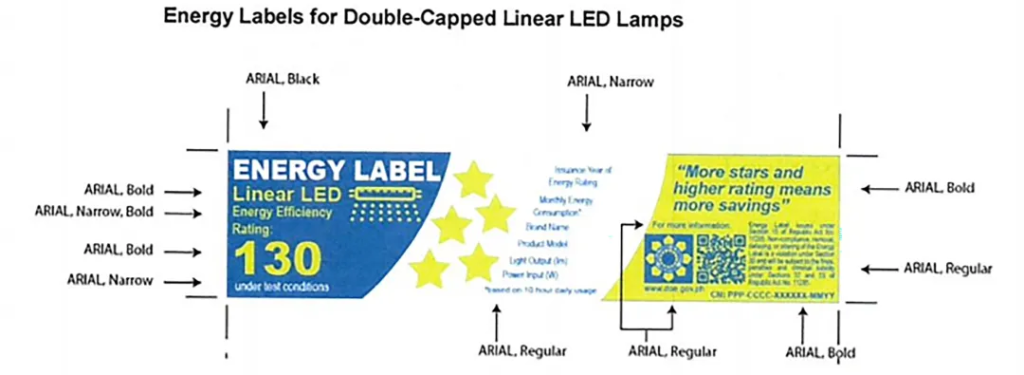
(Energy Efficiency Label Examples)